


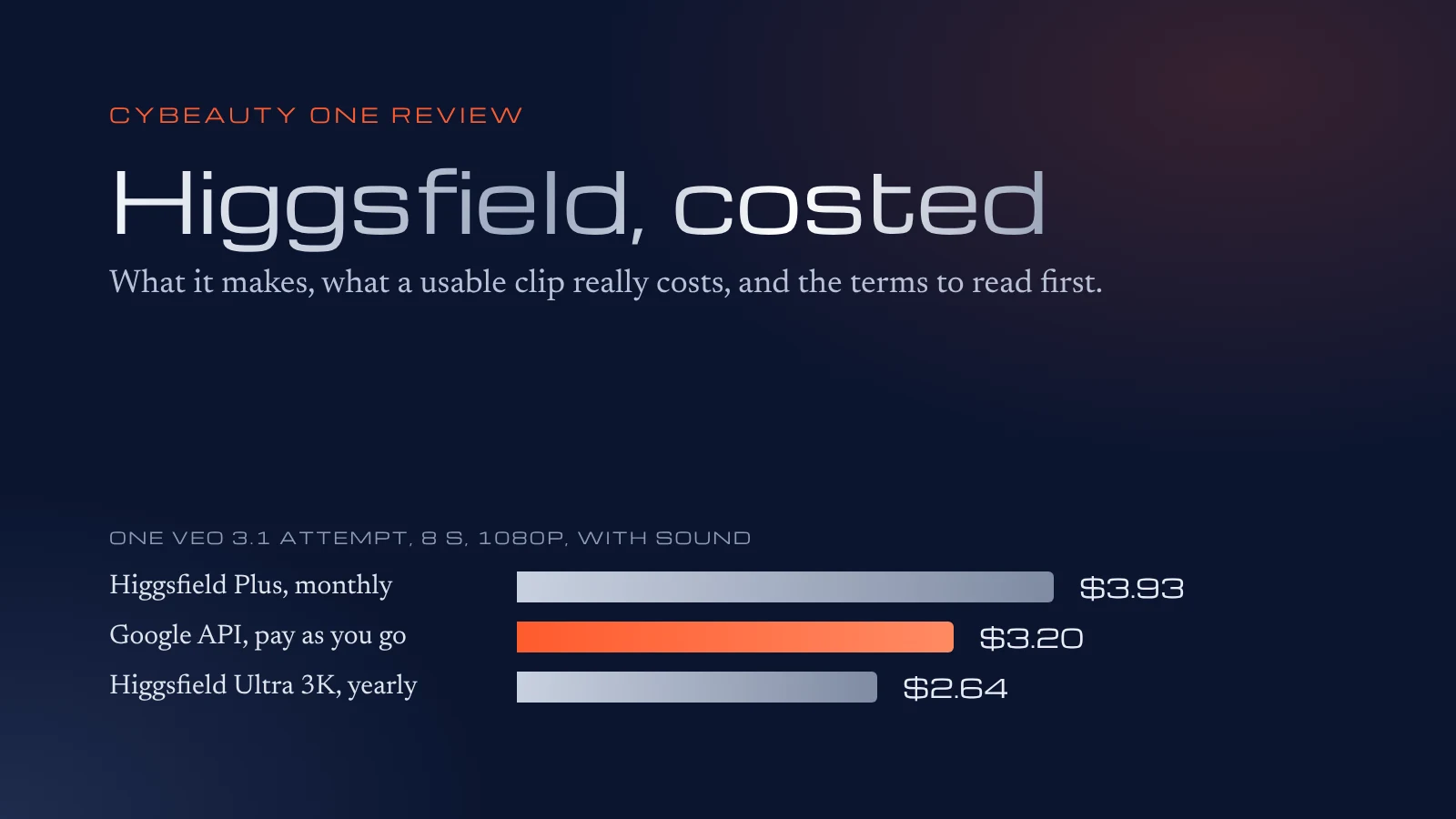
Higgsfield has a $1.3 billion valuation and more than 5,000 reviews on Trustpilot, and AI creators are divided about it. Its fans point to the output and the tools around it. Its critics point to the price of a clip and the terms of use. Both are right, and which one matters more depends on what you make and how much of it.
This review covers what Higgsfield is, what an AI creator can make with it in November 2026, what a usable image or clip actually costs on its plans compared with paying per clip elsewhere, and what its terms say about your content, your face and your money. We used it ourselves in 2025, and that section is clearly marked, because the product has changed a lot since.
Is Higgsfield worth it? For a creator who posts every week, uses most of the monthly credits and wants character, motion and ad tools in one place, yes, especially on Kling 3.0 Pro or on the Ultra 3K plan billed yearly, where a clip costs the same or less than on the cheapest APIs. For occasional use, or for a channel built on Seedance 2.5 or Veo 3.1 on a monthly plan, no: unused credits are lost, and the same clips cost roughly $15 to $68 a month less elsewhere in our example.
What Higgsfield is
Higgsfield was founded in 2023 by Alex Mashrabov, who previously led generative AI at Snap, and Erzat Dulat. It is based in San Francisco and launched its browser product for AI video in March 2025. In January 2026 it announced an $80 million extension to its Series A, valuing the company at more than $1.3 billion, according to Reuters.
It is best understood as a studio app that sits on top of other companies’ models. Through one account and one credit balance you can run Google’s Veo 3.1 and Nano Banana models, ByteDance’s Seedance 2.5 and Seedream, Kling, Wan, Grok Imagine, MiniMax, GPT Image and FLUX, plus Higgsfield’s own image model, Soul. Around those models it adds tools for keeping a character consistent, directing camera moves, transferring motion from your own footage, lip sync and ad production. You pay a monthly or yearly plan for credits, and each generation costs a set number of credits depending on the model and settings.
What we saw in 2025
We used Higgsfield in 2025 for images, video and Soul, both for an AI influencer we run and for a couple of client projects. We were on a plan of about $30 a month that Higgsfield no longer sells.
The work went smoothly. The interface was easy to move around in, the output quality was good, and a usable video clip usually took two to four attempts. What bothered us was the cost, which was higher than on the other platforms we used.
Treat that as a 2025 data point. Since then Higgsfield has repriced its plans, launched Soul 2.0, Soul ID and the AI Influencer builder, added Cinema Studio, Genjutsu motion transfer and an unlimited-model marketplace, and rewritten its terms of use more than once. Everything below was checked in November 2026. The cost complaint, as the tables show, still holds for some models and not for others.
What an AI creator can make with it
A consistent character
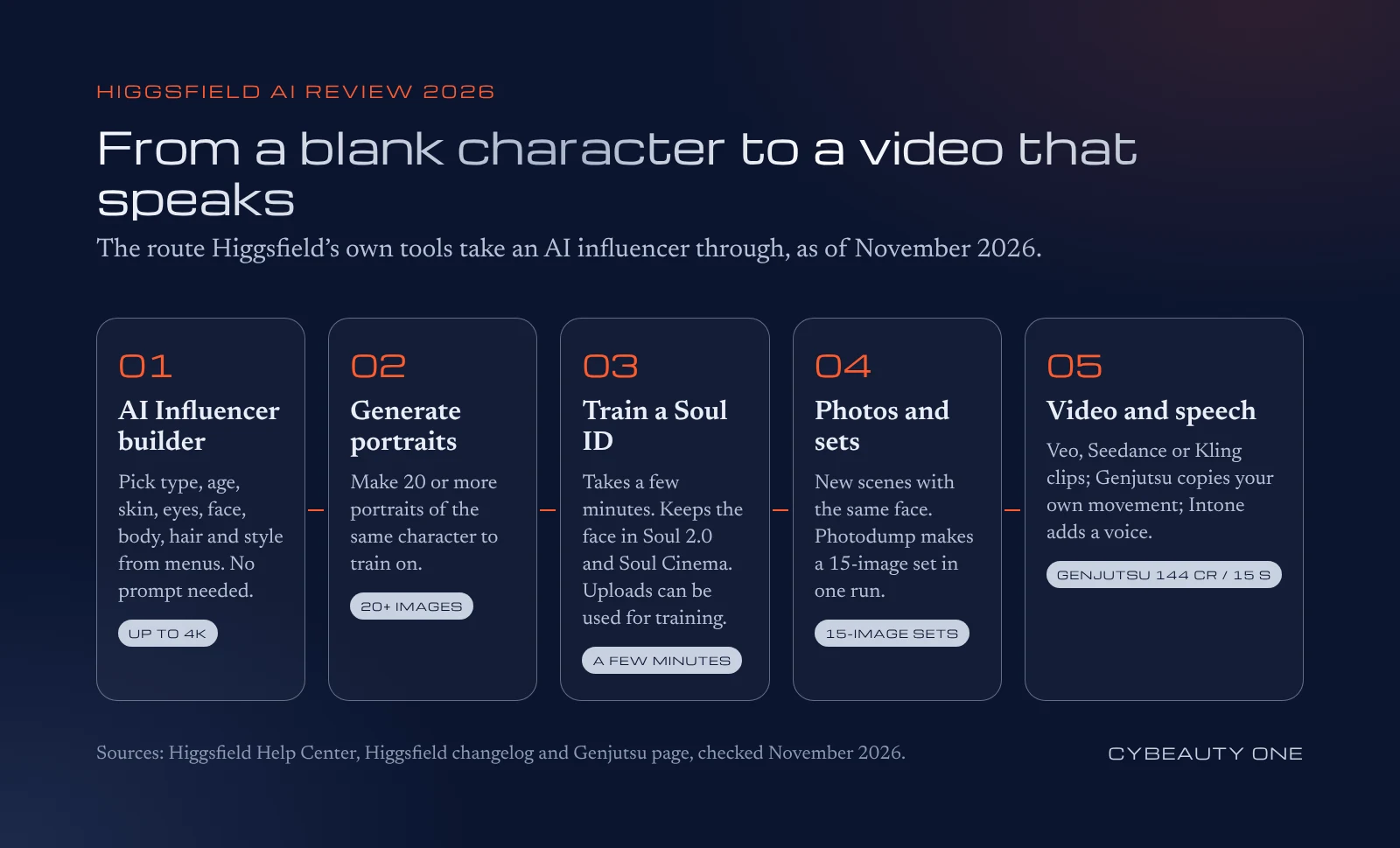
Keeping a face the same from post to post is the hardest part of running an AI influencer, and it is where Higgsfield has put the most work. AI Influencer is a menu-driven character builder: you set the character type, age, skin, eyes, face details, body, hair and style from lists, without writing a prompt, and generate at up to 4K. Higgsfield’s help center then suggests generating 20 or more portraits of the character and training a Soul ID on them, which takes a few minutes. The trained Soul ID works in Soul 2.0 and Soul Cinema, so you can put the same face into new scenes. Soul Photodump makes a 15-image photo set of one character in a single run, which suits a carousel or a “day in the life” post.
Consistency is good, not perfect. In an independent test on a paid Ultra plan, Aliteq put the same AI face into eight scenes: Seedream 5.0 Pro kept all five scored face details in six of eight shots and Nano Banana 2 in four, with misses like faded freckles, a swapped necklace and extra ear piercings. The reviewer judged that none of the shots read as a different person. That matches the general rule for every tool: expect to reject some images for drift and budget for it.
Video, motion and speech
For video, Higgsfield gives you most of the models that matter in late 2026: Veo 3.1 and Veo 3.1 Fast, Seedance 2.5, Kling 4.0 and 3.0, Wan 3.0, Grok Imagine Video, MiniMax H3 and others. Cinema Studio is the workspace for longer pieces, with clips of up to 30 seconds, up to 50 references, camera and color presets and saved projects.
Two tools are particularly useful for AI influencers. Genjutsu takes a source video of 4 to 30 seconds, including footage you film yourself, and transfers its movement to your character, or swaps an object while keeping the rest of the shot. It costs 144 credits for a 15-second clip at 1080p, so it is not a casual tool. Genjutsu Lite costs about a third as much. For speech, Intone makes lip-synced talking clips with a consistent voice, up to 30 seconds per generation, and Lipsync adds speech to an existing clip.
Brand and sponsored work
If your character takes brand deals, Marketing Studio makes ad videos from a product photo or link, Ads Studio builds static ads from a website, and Ad Multiplier recreates an existing ad with new characters, products or locations. These are aimed at marketers, but they fit sponsored posts and UGC-style ads made with an AI influencer.
Higgsfield also connects to other tools: there is a Higgsfield MCP server for Claude, Cursor and other assistants, and plugins for Photoshop, Figma, Premiere Pro and DaVinci Resolve, among others. Generations made through MCP use credits even where the website offers unlimited use.
What it won’t do
Higgsfield is not a tool for explicit content. Its terms prohibit content that is “obscene,” and its help center says safety filters check prompts and uploaded images, that the model providers add their own filters, and that Higgsfield “can’t override safety classifiers manually.” Credits for flagged generations are returned for almost all models. If your character sells adult content on Fanvue or a similar platform, plan to use Higgsfield for the safe-for-work side, such as social posts, teasers and profile images, and to work within those limits.
The terms also require you to have “all necessary rights, releases, and consents” for any real person’s name, likeness or voice you upload. That matters if you train a character on a real model’s photos, including your own.
The plans, and what a credit costs
These are the plans on Higgsfield’s pricing page on November 21, 2026, at regular prices. The last column divides the price by the credits, which is the number to use when you compare anything.
| Plan | Price | Credits a month | Price per credit |
|---|---|---|---|
| Starter, monthly | $19 a month | 270 | $0.070 |
| Plus, monthly | $59 a month | 1,200 | $0.049 |
| Plus, billed yearly | $47 a month | 1,200 | $0.039 |
| Ultra 3K, monthly | $129 a month | 3,000 | $0.043 |
| Ultra 3K, billed yearly | $99 a month | 3,000 | $0.033 |
| Ultra 6K, monthly | $250 a month | 6,000 | $0.042 |
| Ultra 9K, monthly | $375 a month | 9,000 | $0.042 |
| Top-up credits on Plus or Ultra | 40% off pack price | packs from 500 | $0.048 |
| Top-up packs, other plans | pack price | packs from 500 | $0.080 |
A few rules change what those credits are worth in practice. Plan credits don’t roll over to the next billing period, so credits you don’t use are lost and every credit you do use costs more. Top-up credits expire 90 days after purchase. Higgsfield’s free plan has no credits, gives limited use of a few image models and doesn’t allow commercial use, according to Higgsfield’s own pricing guide. According to the same guide, Plus runs up to six videos at once and Starter two.
Plans also include periods of unlimited use on some models, and Higgsfield sells separate unlimited packs. On November 21 every unlimited offer we found was for image models, and the packs work only on the website, two images at a time. For video, Higgsfield sells Bonus Seconds, prepaid pools of seconds for one model that expire 72 hours after purchase. The unlimited windows change every few days, and the terms let Higgsfield slow or limit usage it considers excessive, so treat unlimited as a discount on images rather than a flat rate.
What one attempt costs, against paying per clip elsewhere
Here is the price of one attempt on Higgsfield for the models AI creators use most, at three plan prices, next to the cheapest pay-as-you-go price we found for the same model and setting. Pay-as-you-go means an API platform or the model maker’s own API, where you pay per generation with no subscription.
| Model and setting | Higgsfield credits | Plus, monthly | Ultra 3K, monthly | Ultra 3K, yearly | Cheapest pay as you go |
|---|---|---|---|---|---|
| Veo 3.1, 8 s, 1080p, with sound | 80 | $3.93 | $3.44 | $2.64 | $3.20 (Google) |
| Veo 3.1 Fast, 8 s, 1080p, with sound | 32 | $1.57 | $1.38 | $1.06 | $0.96 (Google) |
| Seedance 2.5, 5 s, 1080p | 80 | $3.93 | $3.44 | $2.64 | $2.85 (BytePlus, estimate) |
| Seedance 2.5, 5 s, 720p | 35 | $1.72 | $1.51 | $1.16 | $1.16 (BytePlus, estimate) |
| Kling 4.0, 5 s, 1080p | 18.75 | $0.92 | $0.81 | $0.62 | $0.55 (Atlas Cloud) |
| Kling 3.0 Pro, 5 s, 1080p, with sound | 10 | $0.49 | $0.43 | $0.33 | $0.755 (kie.ai) |
| Wan 3.0, 5 s, 1080p | 27.5 | $1.35 | $1.18 | $0.91 | $1.00 (Alibaba Cloud) |
| Nano Banana Pro, 2K image | 2 | $0.098 | $0.086 | $0.066 | $0.09 (kie.ai) |
| Seedream 5.0 Pro, 2K image | 2.5 | $0.123 | $0.108 | $0.083 | $0.041 (WaveSpeed) |
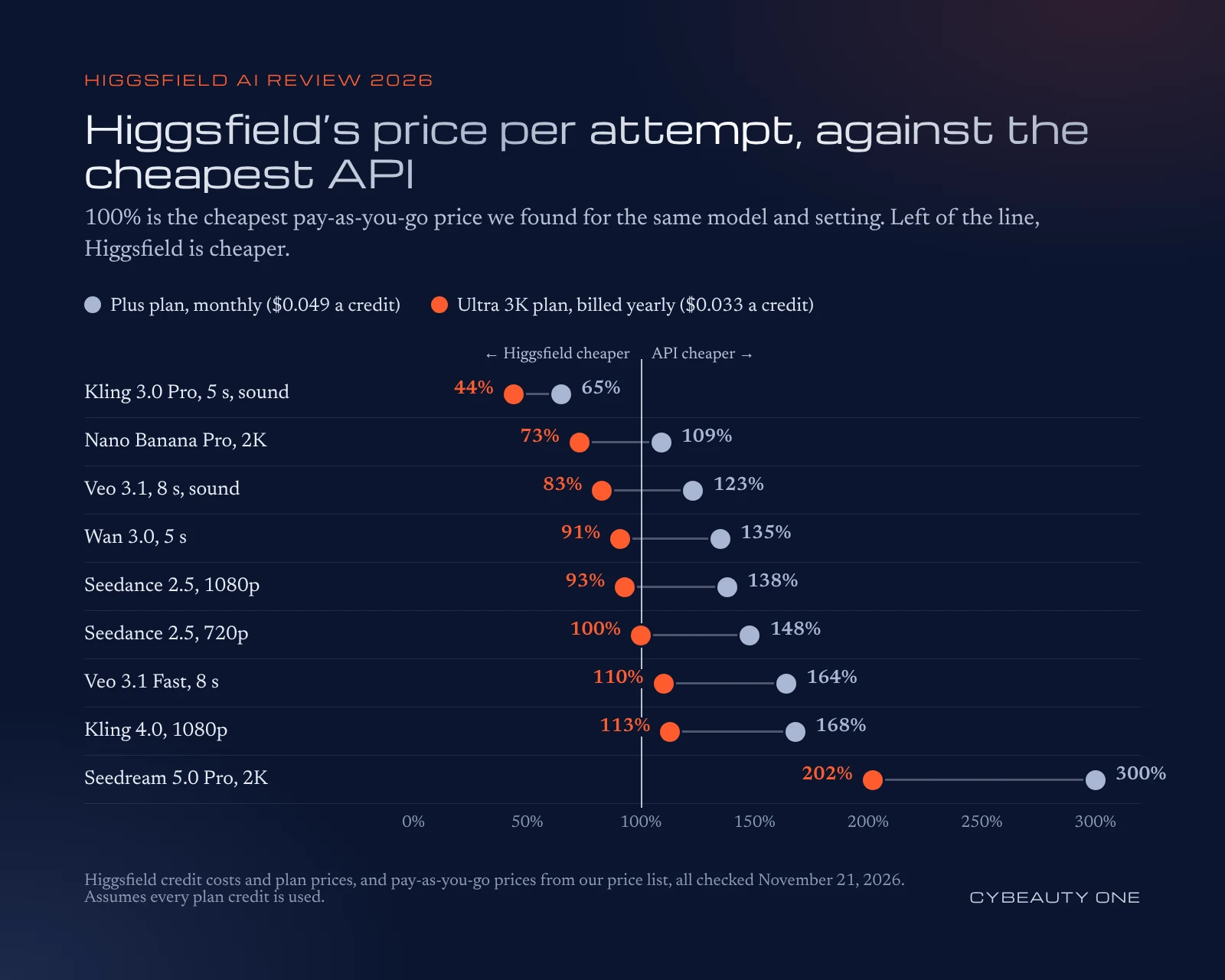
The pattern is clear. On a monthly plan, Higgsfield is dearer than the cheapest API for almost everything. The exceptions are Kling 3.0 Pro, where it is about a third cheaper, and Nano Banana Pro on Ultra 3K, where it is slightly cheaper. On Ultra 3K billed yearly, it becomes the cheaper option for Veo 3.1, Seedance 2.5 at 1080p, Kling 3.0 Pro, Wan 3.0 and Nano Banana Pro, and roughly level on Seedance at 720p. Seedream, Kling 4.0 and Veo 3.1 Fast stay cheaper elsewhere on every plan. Top-up credits at $0.048 or $0.08 make every row more expensive than the plan columns.
Every Higgsfield figure assumes you use all the credits you pay for. If you use 70% of a month’s credits, each one you used cost about 43% more. Wan 3.0 was on sale at 15 credits instead of 27.5 in late November, and Higgsfield runs model discounts often, so the table moves. Our AI model price pages list every platform we track for each model, and the AI content cost calculator works out your own figure.
What a usable clip costs
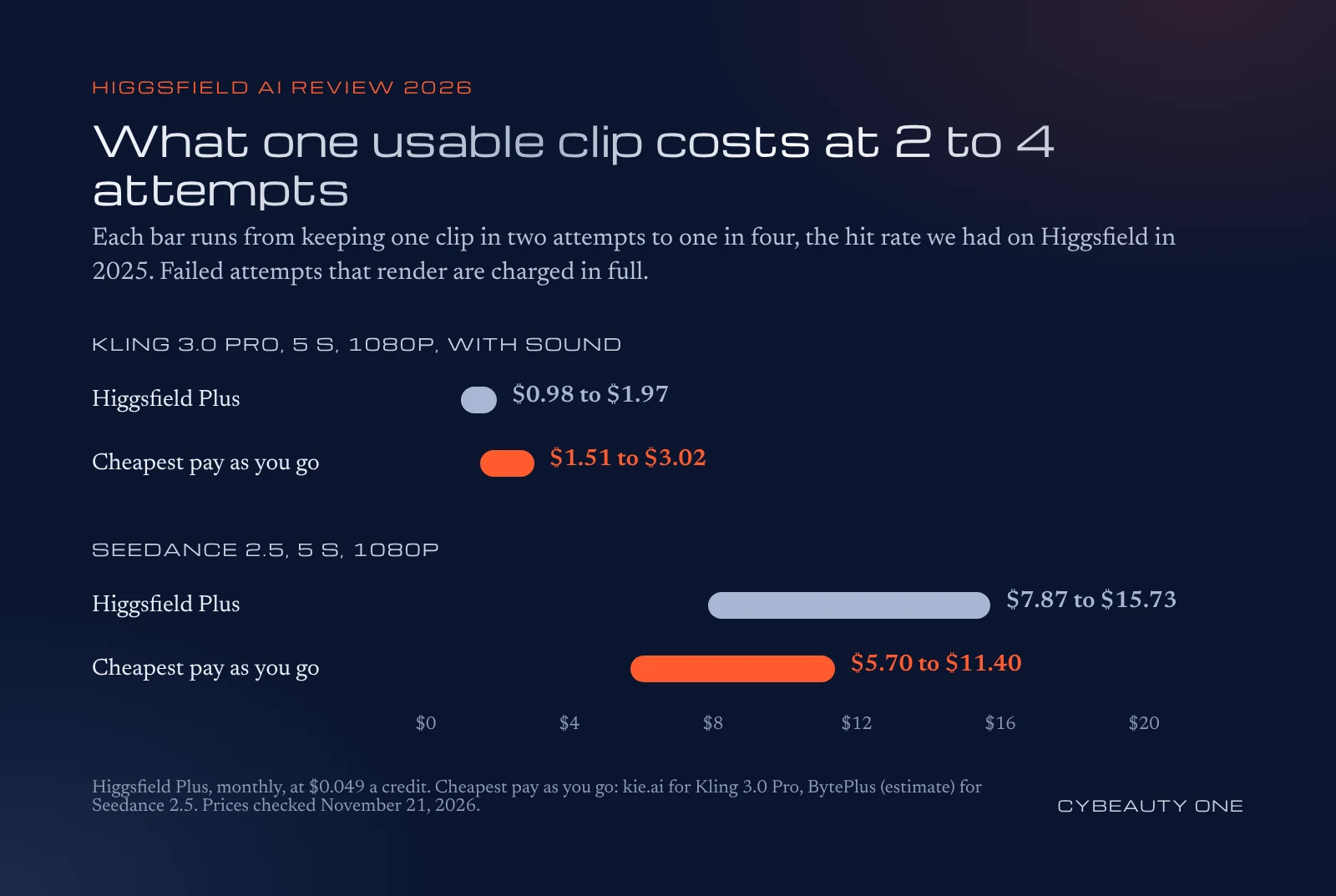
An attempt isn’t a clip you can post. In 2025 we needed two to four attempts for each usable clip, and failed attempts that render are charged in full: Higgsfield returns credits when a job fails with an error, except on Grok models, which charge as soon as they start, but not when the clip simply isn’t good enough. At our 2025 hit rate, on the Plus plan, a usable Kling 3.0 Pro clip costs $0.98 to $1.97, and a usable Seedance 2.5 or Veo 3.1 clip at 1080p costs $7.87 to $15.73. On the cheapest APIs, the same Kling and Seedance clips cost $1.51 to $3.02 and $5.70 to $11.40.
To see what that does to a month, take a creator who posts 60 images and 20 short clips a month, keeps one image in two and needs three attempts per clip. That is 120 Nano Banana Pro attempts and 60 video attempts.
| Video model | Credits needed | Higgsfield | Cheapest pay as you go |
|---|---|---|---|
| Kling 3.0 Pro, 1080p, with sound | 840 | $59 (Plus, monthly, with 360 credits to spare) | $56.10 |
| Seedance 2.5, 1080p | 5,040 | from about $197 (Ultra 3K yearly plus 2,040 top-up credits) to $250 (Ultra 6K monthly) | $181.80 |
On a cheap, fast model the plan and the APIs come out about even, and the plan gives you the interface, saved characters and the other tools for the same money. On a premium model the credits run out long before the month does, the plan needed jumps a tier, and pay-as-you-go wins by roughly $15 to $68 a month. That is the gap we noticed in 2025, and it is still there for the expensive video models.
The example leaves out editing time, which is usually the larger cost, and it treats the APIs as one bill when in practice you would pay three different platforms. Our guide to what AI content really costs after the failed generations covers both.
What the terms say about your content, your face and your money
Higgsfield’s terms have changed several times this year. A version posted on July 23, 2026 drew criticism for a perpetual, irrevocable license to users’ content and for training rights that survived account deletion. Higgsfield published a revised version three days later, and the current terms took effect on October 23, 2026. This is what they say now.
You own your outputs. Higgsfield “does not claim ownership of any of your Inputs or Outputs, nor does it restrict your commercial use of Outputs,” though it doesn’t guarantee that another user won’t get a similar or identical result. Higgsfield’s license to your content lasts only while it is stored on the service and ends when you delete it, with exceptions for backups and content already shared publicly.
Higgsfield can train its models on your inputs and outputs. The terms give no setting to opt out; the stated way to stop it is to delete your content or your account, and anything already used for training stays in the trained models. For an AI influencer that means the reference photos and portraits you upload for a Soul ID can become training data. If your character is based on a real person, or on photos you paid for, decide whether you are comfortable with that before you upload them.
Refunds are narrow. You can ask for a refund within seven days of your first purchase only if you haven’t used any of its credits, a service fee of up to 6% may be deducted, and renewals are generally not refundable. Consumers in the EU and UK have a 14-day withdrawal right that ends once they start using the service. If Higgsfield closes your account through no fault of yours, it refunds unused fees and purchased credits.
Unlimited is subject to fair use. Section 10.6 lets Higgsfield “restrict, suspend, throttle, or place on a slower processing queue” usage that is automated or well above typical individual use, and says speed and capacity are not guaranteed.
What other users report
On Trustpilot, Higgsfield had a score of 4.0 out of 5 from 5,254 reviews when we checked on November 23, 2026, with 62% five-star and 19% one-star reviews. Recent complaints are about credits running out quickly on video, slow video generation, results that don’t follow the prompt, refund requests turned down after the seven-day window, upgrade prompts in the interface and cancellation being hard to find. Recent praise is about output quality, the range of models in one place, ease of use and fast replies from support, including on Discord.
MindStudio has collected reports from Higgsfield’s Discord of cancellations that failed to go through and credits deducted after cancelling. These are user reports rather than verified findings, but they are a reason to cancel well before a renewal date and keep the confirmation.
Pros and cons
What Higgsfield does well, as of November 2026:
- Most of the leading image and video models in one app, with one credit balance
- Character tools built for AI influencers: the AI Influencer builder, Soul ID and Soul Photodump
- Motion transfer from your own footage with Genjutsu, and lip sync with Intone
- Cheaper than any API we track for Kling 3.0 Pro, and cheaper for Veo 3.1 and Seedance 2.5 at 1080p on Ultra 3K billed yearly
- Credits returned for failed jobs and for generations blocked by its filters, except on Grok
- Commercial use of outputs allowed on paid plans
Where it falls short:
- More expensive per attempt than the cheapest APIs on monthly plans for most premium video models
- Plan credits don’t roll over, and top-up credits expire after 90 days
- Refunds only within seven days and only if no credits were used
- Training on your uploads and outputs, with deletion as the only way to stop it
- No explicit content, and filters that support can’t override
- Unlimited use limited to image models and subject to fair-use throttling
- Frequent changes to prices, sale terms and unlimited windows, which make it hard to plan a budget
Who should pay for it
Higgsfield makes most sense for a creator or small studio that produces regularly, uses most of its credits every month and wants the character, motion and ad tools in one place. If your videos lean on Kling 3.0 Pro, or you can commit to Ultra 3K billed yearly, the per-clip price is competitive with the APIs and you get the interface on top.
It makes less sense if you post a few clips a week, since unused credits are lost, or if most of your video is Seedance 2.5 or Veo 3.1 on a monthly plan, where you would pay roughly $15 to $68 more a month than running the same models on APIs. A practical middle route is to use Higgsfield for the character work and stills, and an API platform for the expensive video models.
Whichever you choose, start with one month rather than a year, track attempts and kept clips from the first week, and divide the month’s price by the clips you actually posted. Our AI Plan Picker compares Higgsfield’s plans with the alternatives for the mix of images and clips you make.
Prices in this review were checked on Higgsfield’s pricing page and in its cost quotes on November 21, 2026, and the terms, help center pages and Trustpilot figures on November 23, 2026. Higgsfield changes its prices and offers often, so check the pricing page before you pay.
Free monthly email
Get the monthly price changes
Higgsfield and the platforms it competes with change their prices every few weeks, and the new ones are rarely announced. Once a month we’ll email you what changed and where each model is cheapest to run.
Sources
- Higgsfield, Terms of Use Agreement (effective October 23, 2026)
- Higgsfield, Terms of Use Agreement posted July 23, 2026 (superseded)
- Higgsfield Help Center, How do I request a refund?
- Higgsfield Help Center, Content flagged as NSFW
- Higgsfield Help Center, Generation is stuck or failed
- Higgsfield Help Center, How do I use AI Influencer?
- Higgsfield, Genjutsu (credit costs and Genjutsu Lite update of October 20, 2026)
- Higgsfield, Changelog
- Higgsfield, Pricing explained (free plan and concurrency, verified October 2026)
- Higgsfield, Black Friday Market
- Wikipedia, Higgsfield AI (citing Reuters and TechCrunch, January 15, 2026)
- BGR, the launch of Higgsfield Soul (June 26, 2025)
- Aliteq, Higgsfield review tested on an Ultra plan (tests October 27 to November 8, 2026)
- MindStudio, the Higgsfield terms of service backlash
- MindStudio, Higgsfield subscription cancellation complaints (July 28, 2026)
- Trustpilot, Higgsfield AI reviews
- Cybeauty One, AI model prices (checked November 21, 2026)